Industrial Automation: The transformation of the Modern Manufacturing and business operations.

RPA robotic process automation, automation firms, industrial automation, and manufacturing automation are no longer a concept of the future – they are the engines in the smart factory and digitally transformed companies of today. With growing pressure on industries to enhance their productivity, cut expenses, and offer quality products and services, automation has turned out to be a strategic requirement, and not an optional upgrade. Industrial automation is transforming business operations, competition, and the success of businesses by streamlining redundant digital processes and automating intricate production processes. Introduction into the world of Industrial Automation. Industrial automation can be defined as the application of control systems, machines, software, and technologies to perform processes in industries with the least human intervention. It substitutes manual operations with automated processes to enhance efficiency, accuracy, safety and reliability. They are programmable logic controllers (PLCs) as well as supervisory control and data acquisition (SCADA), robotics, sensors, and sophisticated software platforms. Automated systems are able to run round the clock, respond to new environments and provide data in real time to aid decision making unlike the conventional manufacturing set-ups. This has enabled industrial automation to be one of the fundamental elements of the contemporary industrial ecosystems. History of Automation in the manufacturing industry. Automation in manufacturing has greatly changed within the last several decades. Early automation was centered on mechanization- the use of machine to decrease physical work force. The current automation incorporates the digital intelligence, artificial intelligence (AI), machine learning, and Internet of Things (IoT) to design an intelligent manufacturing environment. In the modern manufacturing, automation by use of modern technology permits: Monitoring the production lines in real-time. Predictive maintenance in order to avoid downtime. Automatic quality control. Intelligence between machines and enterprise systems. With this development, manufacturers have become more responsive to market requirements, are able to scale personalization of products, and are able to provide consistent quality production across production cycles. Application of RPA Robotic Process Automation in Industry. Industrial automation is concerned with the physical processes, whereas RPA robotic process automation targets repetitive digitized operations. RPA involves software bots to imitate the human touch on the digital systems, including data entry, report creation, order processing, and inventory modifications. In industrial setting, RPA is an important supporting activity that: Automation of back-office processes associated with the production. Combining ERP, CRM and manufacturing execution systems. Minimizing documentation and compliance errors by human beings. The speeding up of decision making by processing real time data. RPA, combined with automation in industry, forms a complete automated ecosystem, which links the factory floors and the business. The Major Elements of the Industrial Automation Systems. An efficient industrial automation system comprises of a number of interrelated elements: Control Systems PLCs and distributed control systems (DCS), control the functioning of machinery and guarantee an accurate control of a process within the industry. Industrial Robotics Common applications of the robots include assembly, welding, and packaging, and handling of materials. They enhance speed, accuracy, and safety at the work place. Sensors and Actuators Providers of real time information are sensors including measures of temperature, pressure, and motion and actuators are physical actors that perform physical actions in response to control signals. SCADA and HMI The SCADA systems and human-machine interfaces (HMI) enable the operator to view, manage, and analyze processes on centralized dashboards. Software and Analytics Modern analytics solutions transform raw manufacturing data into action actions, which allows optimizing continuously. Advantages of Industrial and Manufacturing Automation. The benefits of automation in industries are quantifiable on a variety of business performance dimensions. Increased Productivity Automation does not become tired and this increases production and the rate of production. Enhanced Improvements in Quality and Consistency. Robotization reduces inconsistency and human error, which guarantees the uniformity of the quality of products and adherence to standards. Cost Reduction Though the investments can be high at the beginning, the long-term benefits are in terms of saved labor expenses, minimized waste and the optimization of energy consumption. Enhanced Workplace Safety Automation of the risky processes assists companies to secure workers against risky workplaces and minimizes the number of accidents at work. Data-Driven Decision Making The automation systems will be used to create useful operational data that can be used to support predictive maintenance, performance analysis, and strategic planning. Industries that have enjoyed Industrial Automation. Automation in industries is not confined to the manufacturing industry. A number of industries are embracing automation tools in order to improve productivity and dependability. Automobile Motors: Robotic Assembly, quality check and supply chain automation. Pharmaceuticals: Accurate production, automation of compliance and traceability. Food and Beverage: Automation in packaging, hygiene and uniformity in the processes. Energy and Utilities: Predictive maintenance, grid and Automated monitoring. Electronics: Assembly of high speed and precision on a micro-scale. All industries have their own payoffs, yet the purpose is the same, it is operational excellence. The contribution of Automation Companies in the digital transformation. Automation companies are important in assisting organizations to move out of manual or semi-manual systems to complete automation systems. These firms offer system design experience, technology integration experience, software development experience and long term support. Automation Leading companies provide: Specialized automation plans. End to end implementation services. Integrity with the old systems. Future expansion solutions. Through alliances with established automation vendors, companies are able to minimize risks in their implementations and have quicker ROI. Difficulties when Introducing Industrial Automation. Although it has benefits, automation in industries has challenges, which organizations should overcome. High Initial Investment The equipment, software and integration can be expensive particularly to small and medium enterprises. Skill Gaps The design, running and maintenance of a system takes trained workers to handle automation, thus training in the workforce is necessary. System Integration The process of integrating new automation technologies and existing infrastructure may be complicated and time-consuming. Cybersecurity Risks The more the automation systems are interconnected, the greater the importance of securing them against cyber threats. These challenges can be easily overcome with the help of proper planning, staged implementation and expert guidance. Industrial Automation in Future.
MVP Software Development: Engaging Ideas into Market Ready Products

The modern digital world is extremely fast-paced, and a product that succeeds on the market cannot be developed immediately. It is construction of the right thing to begin with. This is where MVP software development will be significant. Enterprises, businesses, and startups are embracing the MVP method of idea validation, less risk and fast time to market. MVP or Minimum Viable Product allows an organization to create working solutions out of ideas using only the most crucial features. Companies no longer need to guess the desires of users, but can use actual feedback and data to inform the development of products. Such tactical approach will save lives in time, money and effort and will enhance the likelihoods of success in the long term. The meaning of MVP Software Development? The MVP software development is a procedure of developing a simple yet effective form of a digital product that aims at addressing a fundamental user issue. It contains only the core aspects needed to bring value to the early adopters. Validation is the major objective of MVP development. Instead of committing to an expensive, richly-featured product, companies launch a bare-bones product to validate their assumptions, learn behavior, and get actionable information. This will enable teams to make a wise decision before the product is scaled even more. MVP development assists in the bridging gap between idea and implementation whether it is a web platform, mobile application, or enterprise system. The significance of MVP Software in the Contemporary Product Strategy The conventional models of product development usually have shown to be very time consuming, expensive and highly uncertain. This is transformed with the MVP software that brings agility and user-centric thinking. That is why mvp software is necessary: It reduces the risk of development through the validation of ideas. It allows quick entry into the market. It makes sure that the features of products are made by actual user requirements. It maximizes development budgets. It promotes the idea of constant improvement by iteration. MVPs make businesses competitive and flexible by concentrating on learning and not perfection. Minimum Viable Product Software: Fundamentals The software of minimum viable product has a few principles on which it is constructed and which determine its success: Focus on the Core Problem MVP is not the number of features added to a product, but it is solving one large problem. The discovery of this issue is the basis of the effective MVP creation. Build with Purpose Each feature that is contained in an MVP should have a specific purpose. In case a feature is not directly relevant to validation or user value it can be delayed. Learn Through Feedback The best deliverable of an MVP is user feedback. The intelligence obtained through actual users assists in developing the future product. Iterate Continuously MVPs are not static. These are developed through testing, data analysis and user feedback and making sure the product gets better with every release. Minimum Viable Product Software Development Process An organized methodology makes sure that MVPs are resourceful and effective. The following is the example of MVP software development lifecycle: Idea Validation It starts with the realization of the problem that is being addressed by the product. Competitor analysis, market research, and identification of the audience can assist in grounding the idea prior to the beginning of the development. Conceptualization and Planning The prototypes are used to visualize the product and test design assumptions. They enable the stakeholders to have the feel of the flow even before real development is carried out. Development At this point, developers create the MVP on agile basis. It is also focused on core functionality and performance as opposed to complete feature sets. Testing Testing will enable the MVP to be tested, be of quality, and offer an easy user experience. Launch and Feedback The MVP is deployed to a target group. Close monitoring is on user behavior, feedback, and performance metrics. Iterative Improvement Future versions are planned to be improved and have more features based on the insights acquired. Minimal Viable Product Development As the need to develop mobile solutions grows, the minimum viable product development has been identified as a major booster of the businesses. Mobile MVPs enable companies to risk test concepts through actual settings in which users engage on a daily basis. The development of mobile MVP pays attention to: Core user flows Performance and usability Android compatibility or iOS compatibility or cross-platform compatibility (platform compatibility). Expandability in the future. With the introduction of mobile MVP, the business can test the app ideas, streamline user experience and develop features before investing in a complete application development. POC, Prototype, and MVP Difference It is important to understand what is the difference between various development stages: Proof of Concept (POC) Technical feasibility is tested by a POC. It provides the answer to the question: Is this idea constructible? It is usually restricted to limited functionality and internal testing. Prototype A prototype aims at user experience and design. It is a representation how the product is going to look and feel but might not be fully functional. Minimum Viable Product (MVP) MVP is a working product that is made available to actual users. It is the most important phase in product development as it is a combination of functionality and validation. Advantages of MVP Software Development to Businesses The benefits of the MVP development are measurable: Faster time to market Lower development costs Less risk of product failure. Data-driven decision making Better correspondence with user requirements. In the case of startups MVPs are used to appeal to investors by showing actual traction. In the case of enterprises, they facilitate innovation without interfering with the normal operations of the enterprise. In what cases Should You Select MVP Software Development? The MVP development would apply in case: It is a new online product that you are introducing. You wish to experiment on a business concept on a small scale. There is a lack of clarity in the market requirements. It is vital
Cloud Computing as a Driving Force of the Contemporary Businesses.

With the nature of businesses changing fast to meet digital requirements, the old IT infrastructure will tend to be a hindrance and not an enabler. Cloud computing removes all these constraints by providing the power of the computer, storage and applications on-demand, without the hassle of having to own and maintain physical systems. This trend gives organizations room to concentrate on growth, innovation, and customer experience.________________________________________ Going Beyond Physical Infrastructure. On premise servers are very expensive to manage as they need capital investment as well as manpower and constant maintenance. Cloud environments substitute this inflexible model with a flexible model, which is consumption-based. Using the services of cloud computing, businesses are able to deploy resources on-demand, scale globally and react quicker to market demands at an affordable cost.________________________________________ Smart Cloud Architectures of the New Workloads. The demands of the current workloads are speed, reliability and scalability. The contemporary cloud platforms are developed to handle a variety of environments including enterprise applications and edge deployments. Virtualized servers provide performance where and when required to allow the companies to deploy mission-critical systems, data analytics, and digital platforms with ease.________________________________________ Storage Which Scales to Data Increase. Information is increasing at an unmatched rate and it is necessary to handle information effectively. Cloud storage is developed to be scaled without any constraints, and they support structured and unstructured data in a variety of applications. Cloud computing services are available to make sure that data can be accessed, safe, and reliable, whether it is a high-performance block storage or a scalable object repositories.________________________________________ The place of Cloud Service Providers in Digital Success. The selection of the appropriate cloud service providers will be a strategic choice. Trustworthy providers do not just easily provide infrastructure, but they provide operation know-how, security systems, and streamlined architectures. Cloud service providers support business risks by managing system availability, updates, and compliance requirements, which allow them to speed up the digital initiative.________________________________________ Scalable Cloud Service Versions to all Business Requirement. Various entities have different cloud solutions. There are several service models that fit unique business objectives that are supported by modern cloud ecosystems: • Computing and storage resource full control infrastructure-based services.• Services of platform which are simple to develop and deploy applications.• Software-as-a-service which offers pre-built applications at a predictable price. The models enable businesses to proceed with cloud technology at their pace without losing the continuity in their operations.________________________________________ Improving Business Continuity and Performance. Cloud systems are constructed in a resilient fashion. The availability is high, and the backups are automated and secured through disaster recovery options that guarantee that the operations are not interrupted even in case of some unexpected events. This is the reason why cloud computing is a critical element of business continuity planning over the long-term.________________________________________ Conclusion Cloud computing is no longer an IT upgrade, it is a business strategy. With the deployment of modern cloud computing infrastructures and collaboration with seasoned cloud services vendors, companies may achieve the aspect of scaling, security, and the long-term innovation. The cloud is the core of a digital-first economy that facilitates smarter decisions, accelerates the execution, and future-ready enterprises.
Telecommunication Services to Support Smooth communication.

Telecommunication Services to Support Smooth communication.In a world where success is determined by connectivity, telecom services become very important in ensuring the smoothness of communication, digital innovation, and transformation in the enterprise. The future of telecommunications is in the hands of Raygain Technologies, a company that is innovating to provide future ready solutions that will enable businesses to build, scale and operate smarter communication networks.Telecommunication Innovation to the Digital Future.Raygain technologies assists in bringing product concepts to life through creation of robust prototypes to serve as market research and customer feedback bases of product development. Raygain provides companies with an opportunity to deploy dependable, confidential and high-quality communication systems by uniting strong telecommunications background and next-generation technologies.Being a reliable service provider to major telecommunications providers like BSNL, Jio, and Airtel, Raygain Technologies provides enterprise-based telecom solutions that will help to satisfy changing business needs.What We Do: Smart Communications of the Future.Raygain Technologies is a CNPN-based partner in the field of the Private 5G services, providing advanced connectivity solutions to the enterprise clients. The company is oriented on the implementation of 5G technologies that provide the possibility of digital innovation, operational efficiency, and the adoption of Industry 4.0.Private 5G ImplementationRaygain is a company that focuses on the development and implementation of private 5G networks in order to provide reliable, secure, and low-latency communications to businesses. These networks share mission-centric applications and promote a smooth connection throughout the industrial environments.Satellite CommunicationRaygain also offers a complete solution of satellite communication which includes designing, installation, and maintenance. These services will provide a high-speed connectivity that is not interrupted even in far and difficult areas.BTS/ Microwave Installation- Commissioning.Raygain technicians work with precise completion, which has established the BTS and microwave installation and commissioning processes to ensure maximum performance, reliability and logical integration with the already installed telecom infrastructure.Industry 4.0 ApplicationsRaygain provides solutions with innovative Industry 4.0, to support the transition of businesses to smart factories and automated systems. Such applications lead to digital transformation, improve productivity and enable smart decision-making.Easy to Install. Secure to Work. Simple to Operate.Telecom solutions developed by Raygain are enterprise usable i.e. easy to deploy, secure in operation and easy to manage hence are suitable to enterprises who want to achieve scalability and reliability in communication systems.Our CapabilitiesRaygain Technologies has a wide range of knowledge in various frequency band and deployment models including:• 5G services at 700, 900, 2100, and 2500 MHz• P5G 3600 and 3900 MHz Proof of Concept, Private.These attributes make Raygain a trusted technology alliance to businesses and telecom firms that require cutting-edge connectivity services.Reliable amongst Major Customers and collaborators.Raygain Technologies has established a solid reputation with a wide range of customers in the various industries, with the large ecosystem of technology partners. The business partnership model empowers the provision of future-proof, scalable, and high-quality telecom services.Why Raygain Technologies.Certified ProfessionalsTechnical excellence in projects is guaranteed by a team of certified engineers whose credentials are DELL, HP, CISCO and D-LINK.Effective Operational Capability.Quality, security and reliability Operations surrounded by globally known certifications such as CMMI Level 5, ISO 27001, ISO 9001, ISO 20000 and ISO 22301.Varying Industry Experience.Long-term expertise in manufacturing and production sectors, which allows the development of complex solutions to the conditions of the enterprise.Specialization and Expertise.Niche skills on cloud technologies and innovative telecommunication solutions, offered by experienced people.Cost EffectivenessAvailability of access to talented professionals and business-level telecom services at compressed and effective prices.Constant Provision and streamlining.Continuous observing, labor, and streamline to secure the current resources and continuous performance.ConclusionRaygain Technologies is a reputable telecom service provider that provides innovative, security based and scalable solutions to enterprises and telecom internet provider ecosystems. Raygain is bringing forth the future of smart communications through a mix of private 5G, satellite communication, and Industry 4.0 applications and enabling businesses to succeed in a connected world.
MVP Development: How to Transform Giant Ideas into Market-Ready Products

MVP development is now the most intelligent approach to create successful digital products in the world where speed and validation are highly valued, rather than perfection. Businesses are currently putting their projects online in a lean form rather than spending months of their time in the full development of their idea, testing it out in the real world, and improving quicker than their competitors. It is in this area that the right MVP development strategy is all that counts. Why the MVP Development is the Wiseest Way of the Builds MVP development enables a business to experiment to learn as much as possible but at a minimum risk. The idea is quite straightforward, develop only what is needed, put it in the hands of actual users, and allow the feedback to define the future. MVP development has several benefits such as: Faster time to market Reduced development cost Early user validation Strong product-market fit An ideal MVP software development strategy will ensure that the companies do not rely on assumptions, but instead make decisions grounded in data at the earliest stage. How to Develop an MVP: Idea to Impact All products start with an idea but very few ideas come up into successful products. The process of developing an idea into the market is filled with a need to be clear, iterate and execute. Idea & Concept Validation The product idea should be tested out before a single line of code is written. This involves the realization of: The issue that the product is addressing. The target audience Market feasibility Effective MVP development services are based on this initial validation stage. Prototyping the Vision Prototypes can be used to see the picture of the product and test its usability before the development starts. At this phase, companies are able to make design, user experience, and workflow refinements without requiring substantial investment. Prototyping helps make sure that the development of MVP is not dependent on guesswork at its beginning. Building the MVP This is where the main concept will be realized. The MVP consists of features that are necessary and which address the main user issue. Nothing extra. Nothing unnecessary. Powerful MVP development companies are concerned with: Core functionality Scalable architecture Clean and secure code Testing, Feedback & Iteration When the MVP is in operation, actual users give actual feedback. Feedback drives: Feature enhancements UX improvements Performance optimization It is this feedback loop that makes MVP change into a full-fledged product. Evidence of Concept, Prototype and MVP: Difference Between the Two The stages though interchangeably used are used differently in product development. Proof of Concept (PoC) A PoC provides answers to one question, that is, Is this idea technically possible? Validates feasibility Reduces technical risk Attention to functionality, but not to design. Prototype A prototype is dedicated to appearance and touch of the product. UI/UX validation Design and usability testing. Can be low or high fidelity Minimum Viable Product (MVP) MVP is a functional product that has been handed out to the market. Has fundamental characteristics. Targets early adopters Collects user feedback Evolves through iterations Values to Expect Under Professional MVP Development Services MVP development services of high quality are not limited to coding. They are a combination of strategy, design, technology and business thinking. Key elements include: Product idea validation User-centric design Agile Multiple Velocity Programming software development. Strict examinations and quality control. The continuous loop of improvement and support. The correct strategy is one that will see your MVP not only released but set up to prosper. Selecting the MVP Development Company Such companies of MVP development do not provide the same value. The partner of choice must provide: Professional and qualified developers. Efficient development models. Industry-specific experience Scalable and cost effective solutions. A seasoned MVP partner will also assist you in going fast without causing quality and scalability costs later on. MVP Development It’s Learning-Fast Building-Smart The concept of MVP development is not to make a smaller product, but a smarter one. Given the attentive approach to the actual needs of users and the continuous improvement, businesses can develop solutions that really matter. When your idea has the right MVP software development partner, it does not just launch, but expands, grows, and thrives. Ready to Build Your MVP? Another reason why you should take the first step is when you want to have reliable MVP development services of one of the trusted MVP development companies. Build fast. Learn faster. Grow smarter.
Digital Transformation: Making Technology a Business Engine.
In the current fast changing digital economy, organizations can no longer afford to use conventional processes in order to be competitive. Digital transformation is now a strategic need and not a dream of the future. It is not merely about the new technologies adoption- it is the way of redefining business operations, the way of the provision of values, and the way of reaction to the changes in the market requirements. Victorious enterprises consider the digital transformation as a long process that is able to align technology to people, processes and business objectives. The meaning of Digital Transformation. Digital transformation can be described as the introduction of digital technologies in every sphere of the business in order to enhance efficiency, agility, and customer experience. It transforms the manner in which organizations operate within and interact with the outside environment with customers, partners and stakeholders. This change cuts across all the spheres of the organization, such as operations and marketing, customer service, and decision-making. Companies that adopt this change are able to achieve quicker learning, enhanced scalability and competitive standing. The reason behind why digital transformation is an urgent issue to contemporary businesses. The current markets are fast, data intensive, and focus on customer expectations. Those companies who take long to adopt digital will be left behind more nimble competitors. An effective digital transformation plan helps companies to: Automate operations and save on operation expenses. Enhance customer experience by getting personal and automating. Instantaneously make decisions using data. Quick adaptation to changes in the market and technology. Improve inter-team and inter-location cooperation. Finally, the digital transformation is beneficial to the sustainable business transformation as it allows organizations to keep changing. How to Construct a Digital Transformation Strategy. Effective digital transformation plan begins with an effective vision and targets. It is to be put in line with the business objectives of the enterprise as opposed to being a solitary IT project. The important components of a good strategy are: Determining the present digital maturity and gaps. Determining business processes that have high-impact to transform. Choosing scalable and secure digital technologies. Organizing teams and change management training. Establishing performance indicators to monitor the advancement. The highest returns on investment and long-term operational sustainability are attained in the organizations that look at the digital transformation strategically. Digital Transformation Company Role. The collaboration with successful companies in digital transformation may also be used to speed up the change process. These firms introduce experience and best practices in the industry, established systems and technical capacity to enable companies to put in place the appropriate solutions in an efficient manner. Digital transformation partners assist companies with: Road map planning and strategy development. Implementation and integration of technology. Optimization and automation of the processes. Cloud adoption and data analytics. Continuous improvement and development. Selecting the appropriate partner will make sure that technology projects provide quantifiable values to business instead of just technology upgrades. Business Transformation as a Product of Digital Transformation. Business transformation is actually achieved when digital initiatives result in major changes in the value creation process within a firm. This involves re-invention of business models, improving customer interactions, and developing operations that are future oriented. Digital transformation will enable companies to leave behind reactive business operations and be prepared to adopt proactive and insight-driven decision-making. It establishes a platform of innovation, growth and long term success in a world that is becoming more digital. Conclusion Digital transformation is not a choice anymore as it has become a necessity to organizations that want to be relevant and competitive. Through an effective digital transformation policy and collaboration with the appropriate digital transformation firms, companies can achieve efficiency, innovation, and sustainable growth. Companies investing in digital transformation now will be more likely to take the future markets confidently and swiftly.
Off-Shore Development Center: Making Global Distance a Strategic Competitive Edge

A majority of businesses do not struggle due to bad ideas. This is a problem since they cannot implement execution on the same level as ambition. Local hiring is slow. Appropriate skills are not high. Technology is changing at a quicker pace than the teams can adapt. This is where off-shore development centre becomes not merely able to be an option but becomes a strategic decision. A growth bottleneck is an off-shore development centre (ODC) that is constructed to eliminate these growth bottlenecks without introducing any operational complexities. The Reason Off-Shore Development is Effective in the Field Off-shore development does not entail outsourcing work. It is concerned with redistributing capability to the best places. Through off-shore development centre, organizations can have instant access to professionals, process-driven and scalable delivery without a loss of control in decision-making and ownership. The result is not dependency. The result is leverage. The Model of the Off-Shore Development Centre Demystified An off-shore development centre is a long-term and permanent expansion of your in-house team but which operates in a foreign country but is geared towards the same business objectives. An ODC provides unlike the conventional models of outsourcing: Exclusive team allocation Rapid infrastructure and security of data. Constant cooperation, not delivery on a ticket basis. This renders off-shore development predictable, measurable and sustainable. Constructed on Security, Contrived to Trust Data protection is one of the largest issues regarding off-shore development. What a worry–but something that can be dealt with. An off-shore development centre is mature and is governed by a rigid security measures, international complies and access control measures. These are your intellectual property, customer data, and business logic that is protected in each stage. Security is not an add-on. It is the foundation. Models of engagement which fit you Development off-shore is successful where flexibility is inculcated in the model. Dedicated Off-Shore Teams In the long run, all-time dedicated specialists who will work strictly on your projects. On-Demand Specialists Short-term specialists were contracted to perform a given task, migration, audit or improvement. Hybrid Scaling Growing your business, small to big, or restructuring teams as you go–without operation headaches. An off-shore development centre neither works against your roadmap nor expands it. The Actual Delivery of an Off-Shore Development Centre In addition to cost efficiency, an ODC provides reliability of execution in: Modernization and Software development. Constant Testing and Quality Assurance. IT Infrastructure Management. Maintenance and Production Support Systems. Project Governance / Delivery Governance. All these functions will minimize risk, enhance speed, and consistency. The actual Business advantages of Off-Shore Development Talent Without Borders Tap into an international pool of highly qualified personnel without the restriction of geography. Scale Without Disruption Grow or shrink without recruitment or retrenchment or sunk cost. Cost Control With Quality Reduce costs of operation yet offer enterprise grade standards. Industry-Driven Experience Teams The teams were experienced in manufacturing, process automation and production environments where reliability is of essence. Norms, Qualifications, and Hard capability The off-shore development centre has to be credible, and to prove this, it should operate with an excellent operational maturity as evidenced by the following certifications: CMMI Level 5 ISO 27001, ISO 9001 ISO 20000, ISO 22301 This, together with the certified engineers of DELL, HP, CISCO and D-LINK, will guarantee the quality and technical confidence. Developed Specialization in the context of the contemporary business Whether it is cloud transformation, infrastructure optimization, off-shore development presents a specialized area of knowledge where it is needed most without diluting your internal team resources. Technology evolves quickly. Implementation has to become quicker. The reason why Off-Shore Development is a Long-Term Strategy Off-shore development centre is not a short cut cost-reduction. It is a long-term operating model of companies that would like to: Build faster Scale smarter Reduce execution risk Stay competitive globally With proper implementation, off-shore development will be a growth enabler, rather than a dependency.
Industrial Automation: Greener Business Smarts by Digital Transformation
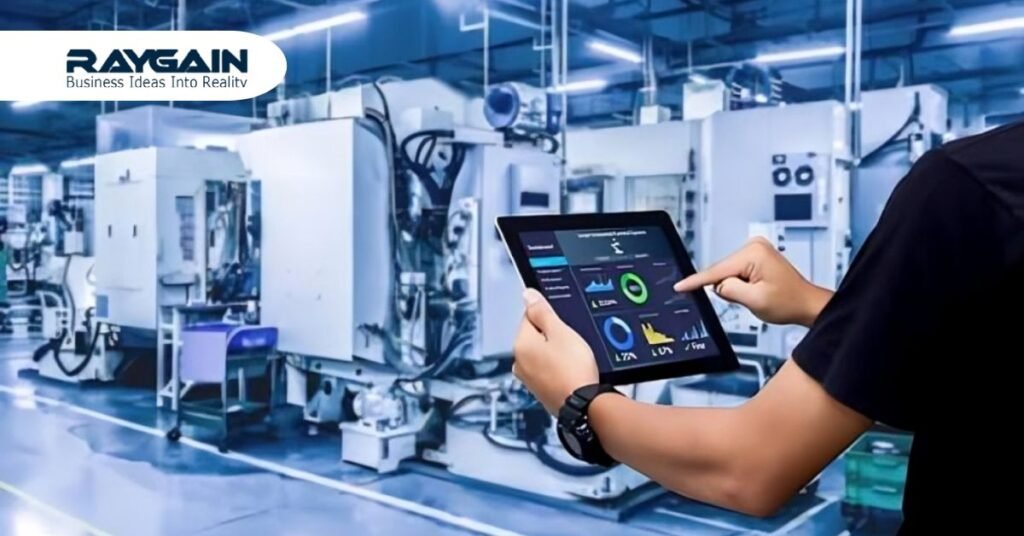
Industrial automation is now a key facilitator in a fast-changing digital economy, that any business wishing to make more out of efficiency, agility and innovation. Companies in all industries are embracing intelligent automation as a way to modernise their activities, decrease manual labour and achieve up-to-date information that can be used to make improved decisions. Being among the small automation firms, Raygain Technologies provides high-tech service solutions of industrial automation that aim at ensuring that the enterprises streamline their processes and remain competitive in the ever more automated world. Industrial Automation: Improve Business Agility The automation of industries in this modern era is more than mechanization. It integrates digital technology and smart technologies to innovate adaptive and data-driven systems. Through introducing a powerful industrial automation service, companies will be able to: Simplify the flow of business processes. Optimize effectiveness and efficiency of operation. Reduce downtimes and human error. Quicken innovation and scalability. Automation enables the organizations to act fast in line with the market changes without sacrificing operational consistency and quality. Intelligence to Innovation within the Pace of you require Raygain Technologies adheres to an outcome and systematic plan of automation that yields quantifiable effects. Discover Business processes are constantly being examined by us to establish areas of improvement and untapped efficiencies that can be tapped using automation. Automate Our team creates and develops an interconnected automation core that changes the manner in which organizations are run with a removal of barriers in between systems, data as well as workflows. Operate We implement and operate AI-based automation throughout the enterprise, which guarantees efficient performance, security, and scalability in the long term. What We Do: E2E Industrial Automation Service With a more innovative future, we assist businesses in the transition of a more efficient environment through the development of an interconnected automation ecosystem. Process Automation Our complex business problems are solved with the help of software and robotics technologies, and workflows are automated, and important information is centralized. Our RPA solutions will allow companies to accomplish complex and repetitive tasks with accuracy, speed, and consistency- without affecting quality. Smart Manufacturing We help in real-time monitoring and the use of analytics-driven decisions in the manufacturing processes through IoT-enabled systems. AI and Machine Learning Our AI/ML solutions are used to improve problem-solving, forecasting and intelligent decision-making by using information and powerful algorithms. The Intelligent Document Processing (IDP) Our system applies safe authentication and authorization mechanisms, in most cases, single sign-on (SSO), to control and secure access to multiple platforms. Reliable Brand among the automation firms Raygain Technologies has a variety of clients and partners with whom they provide quality service solutions of industrial automation that facilitate business goals. Technical skills and our corporate culture as a co-operation make us one of the reliable partners of contemporary automation firms. What is the reason to use Raygain Technologies? Certified Professionals We also have specialized DELL, HP, Cisco, D-Link, and other technology suppliers certified engineers. Sound Operational Strengths We support internationally acclaimed qualifications like CMMI Level 5, ISO 27001, ISO 9001, ISO 20000 and ISO 22301. Industry-Focused Experience We carry with us vast experience in dealing with manufacturing and production based organizations. Specialized Expertise Our professionals are providing customization of industrial automation and cloud-based services that are aimed to suit the particular business requirements. Cost-Effective Engagement Get access to professionals and high-end automation at an optimized price. Constant Support and Optimization Our continuous monitoring and control will ensure that the automation systems are efficient and future-oriented. Industrial Automation: Change Your Operations With the growth in the dependency of intelligent systems by businesses, it is critical to select an appropriate industrial automation service provider. Raygain Technologies is one of the emerging companies in the field of automation today that can be considered innovative through the delivery of scalable, secure, and innovative automation. Collaborate with Raygain Technologies and automate smarter to innovate faster and an efficient digital future.
Trusted Cloud Service Providers – Cloud Computing Services

The digital-first world of business demands organizations to have flexible, secure, and scalable IT solutions in order to be competitive. Cloud computing has turned into the backbone of the contemporary IT infrastructure such that business can have access to resources as needed and not as limited by the traditional systems. Raygain Technologies is one of the trusted cloud service providers and offers end-to-end cloud computing that drives its performance, expansion, and digital transformation. What Is Cloud Computing? Cloud computing refers to the provision of computing facilities (servers, storage, databases, network and software) through the internet. Businesses do not need to manage physical infrastructure, and they can access these services anywhere and at any time with the help of cloud providers. This will enhance flexibility, minimize expenses and ensure smooth cooperation among departments. Why Companies Are Adopting Cloud Computing Services Some of the business benefits that organizations derive by collaborating with experienced providers of cloud services include: Elastic infrastructure to suit the dynamic business needs. Economy with the pay-as-you-use pricing models. Very high availability and reliability of the critical applications. Better performance using optimized cloud environment. Greater data security and protection taken care of by accredited cloud providers. Under cloud computing services, business owners can get to business innovation whilst infrastructure management is done by the professionals. Raygain Cloud Computing Solutions Raygain Technologies also provides end-to-end cloud computing services, which are aimed at satisfying the needs of present-day businesses. Our solutions are produced in such a way as to provide flexibility, security, and long-term value. Cloud Servers Our cloud server offerings are high-performance and reliable when it comes to workloads by the enterprise. We offer: Rack Servers Tower Servers Edge Servers Mission-Critical Servers High-Density Servers These solutions also allow businesses to operate and take advantage of the scalability provided by the top cloud providers. Cloud Storage Solutions There is a need to ensure that data management is done effectively in cloud environments. We provide cloud storage services, which are: Single storage centralized data access. Block Storage of performance intensive applications. Shared and structured information file storage. Unstructured Hard disk storage of large volumes of data. These storage systems provide secure, scalable, and reliable data access to cloud systems. Models of Cloud Service That We Support Being a long term cloud service provider, we support several cloud models to meet the business objectives: Infrastructure as a Service (IaaS): Virtual computers, disk drive, and network services. Platform as a Service (PaaS): Development platforms based on the creation of applications and their deployment. Software as a Service (SaaS): The internet-based applications. Both of the models streamline operations and speed up digital growth. Why Raygain Is a Cloud Service Provider of Choice Collaborating with Raygain Technologies would guarantee: Skills in certified cloud specialists. The personalized cloud systems based on your business. Compliant and secure clouds. High quality support and constant optimization. Affordable solutions by credible cloud providers. We assist the businesses to embrace cloud technologies with trust and transparency. Cloud Computing to Power Your Enterprise Digital transformation requires the selection of appropriate cloud service providers. In the case of Raygain Technology, companies have an opportunity of accessing trusted cloud service solutions, which enhance efficiency, scalability and performance. We can assist you in maximizing the power of cloud computing by providing solutions that will be a long-term success. Call Raygain Technologies today and discuss solutions to the cloud that meet your business objectives.
IT Infrastructure: The Foundation of the New Digital Businesses.
In the current world that is driven by technology, businesses are highly dependent on digital platforms on which they operate and communicate and expand. At the heart of this digital ecosystem is the IT infrastructure that is needed to give the backbone that is needed to support applications, websites, data and business operations. A strong IT network is reliable, performs, scaling, and secure in terms of all digital touchpoints. Be it an organization operating a basic business web site or the complex enterprise applications, a strategized IT infrastructure is very important in ensuring that users have routine user experiences and that there is a continuity in operations. What Is IT Infrastructure? IT infrastructure is the collection of hardware, software, networking facilities and services that facilitates the provision and administration of the IT setting. It facilitates processing, storage, communication, and managing of systems needed in the operations of the business. Basic components of IT infrastructure are: Computing systems and servers. Routers and switches are networking equipment. Storage databases and systems. Middleware and operating systems. Significance of IT Infrastructure to Websites. The quality of IT infrastructure of a particular site directly influences its performance and reliability. Infrastructure may be bad and thus cause downtime, slow load times, and security vulnerabilities, which bring with them a negative impact on business credibility. The Critical Advantages of a Powerful IT Infrastructure. Performance and Speed An efficient infrastructure will guarantee reduced loading time, smooth flow of content and enhanced user interaction. Reliability and Uptime Data Protection and Security High level of security measures protects sensitive information, guard against cyber attacks as well as industry standards. Scalability IT infrastructure enables websites and applications to scale with a rise in business demands and does not lead to performance degradation. Important parts of IT infrastructure of the Web site. Server and Hosting Environment. Web server is used to store files, applications and databases of websites. Depending on the needs, businesses are able to use on-premise, cloud-based or hybrid hosting. Network Infrastructure High network backbone will also mean secure and swift data transfer between the servers and customers. Storage and Backup Systems To have a disaster recovery and business continuity, it is necessary to have reliable data storage and frequent backups. Security Framework Infrastructure protection against cyber risks is provided by firewalls, encryption, access control, and monitoring tools. Monitoring and Management Constant surveillance is used to detect performance problems in time and provide stability of systems. Businesses IT Infrastructure Services. Businesses in the modern times need skilled services to handle complicated ITs. IT infrastructure services are aimed to plan, deploy, and sustain infrastructure in line with business objectives. These services normally involve: Infrastructure analysis and design. Performance optimization Security implementation Continuous overseeing and assistance. Organizations have the opportunity to cut the risks in their operation and enhance efficiency by using professional IT infrastructure services. Information Technology Infrastructure as a Service (IaaS). Due to the advent of cloud computing, IT infrastructure as a service (IaaS) has been a popular option among companies that desire flexibility and cost leadership. Advantages of IaaS Pay as you drive computing services. Ready scalability in accordance with the workload needs. A high level of availability and redundancy. IaaS helps organizations to concentrate on innovation and development whereas infrastructure is operated by scaling cloud solutions. Evaluating the Right IT Infrastructure Strategy. The infrastructure strategy to be adopted is determined by the size of the business, industry needs, traffic volume and sensitivity of the data. Balanced approach guarantees performance, security and scalability without superfluous complexity and expensive. An IT infrastructure that is properly installed offers long-term digital transformation and prepares businesses to meet the changing technology requirements. Conclusion Every successful digital business is based on IT infrastructure. It is crucial in promoting performance, security and scalability of web sites, as well as enterprise applications. The right IT infrastructure and services will help businesses to run smoothly, reduce risks, and remain competitive in a more digital environment.