How Vehicle Monitoring Systems Improve Fleet Safety and Efficiency

In today’s fast-paced transportation and logistics landscape, keeping fleets safe and efficient is a top priority. A vehicle monitoring system provides real-time tracking, behavioral insights, and intelligent automation to help businesses achieve operational excellence. As businesses increasingly rely on data to drive decisions, vehicle monitoring becomes essential to protect assets, enhance performance, and ensure compliance. What is a Vehicle Monitoring System? A vehicle monitoring system combines GPS, telematics, and IoT-based sensors to collect, transmit, and analyze data from vehicles in real-time. It monitors various parameters including speed, location, fuel usage, maintenance needs, and driver behavior. Fleet managers use this data to improve safety protocols, reduce operational costs, and ensure that vehicles run at peak performance. These systems are particularly valuable for logistics companies, delivery services, construction fleets, emergency services, and public transportation providers. Safety-First Approach Safety is one of the primary benefits of implementing vehicle monitoring systems. Efficiency-Driven Performance Operational efficiency can make or break a business. Vehicle monitoring systems optimize workflows and boost productivity. Enhancing Customer Experience Happy customers are repeat customers. Timely and predictable deliveries, accurate ETAs, and fast issue resolution are all enabled by vehicle monitoring. Ensuring Compliance and Reducing Risk Vehicle monitoring systems also help organizations meet regulatory requirements and reduce liabilities. Use Cases Across Industries Future of Fleet Management with AI and Data Analytics AI-driven analytics can interpret vehicle monitoring data to predict maintenance needs, optimize fuel strategies, and detect driver fatigue before incidents occur. Integration with cloud platforms allows remote monitoring and advanced reporting. The evolution of vehicle monitoring systems is closely tied to the rise of autonomous vehicles, 5G, and V2X (Vehicle-to-Everything) communications. Businesses that adopt these technologies today gain a major competitive edge. Why Choose Raygain Technologies? At Raygain Technologies, we offer robust, scalable, and secure vehicle monitoring solutions customized for your industry needs. Our systems are designed to deliver maximum visibility, control, and ROI. From real-time GPS tracking to predictive analytics, Raygain is your trusted partner in smart fleet management. 📞 Want to experience seamless fleet safety and efficiency? Contact Raygain Technologies today to schedule your free consultation and learn how our vehicle monitoring systems can transform your operations.
How Video Analytics Is Transforming Industrial Safety

In today’s fast-evolving industrial landscape, safety isn’t just a regulatory requirement—it’s a vital component of operational success. As industries grow more complex and automation takes center stage, businesses are turning to intelligent technologies like video analytics to enhance safety, reduce risks, and ensure compliance. What Is Video Analytics? Video analytics is the use of AI-powered algorithms to automatically analyze video footage in real time or from recorded streams. This technology enables systems to detect, track, and respond to specific events or behaviors—without the need for constant human monitoring. By combining CCTV infrastructure with intelligent software, organizations can transform passive video surveillance into a proactive safety solution. Why Industrial Safety Needs Video Analytics Traditional safety measures often rely on manual observation, periodic inspections, and reactive reporting. However, these methods are prone to human error and may delay the response to critical incidents. Video analytics eliminates these limitations by providing: Key Applications of Video Analytics in Industrial Safety Let’s explore how video analytics is being used to improve safety across manufacturing plants, warehouses, construction sites, and more. 1. PPE Detection Ensuring that workers wear personal protective equipment (PPE) like helmets, gloves, and vests is crucial. Video analytics can automatically detect if any worker enters a restricted zone without the required PPE and trigger an immediate alert. 2. Zone Monitoring and Intrusion Detection High-risk areas such as machine zones, electrical panels, or chemical storage units require restricted access. Video analytics can monitor these zones and identify any unauthorized entry, helping to prevent accidents and security breaches. 3. Fall Detection and Worker Safety In hazardous environments like oil refineries or construction sites, fall detection is critical. Video analytics systems can identify slips, trips, and falls in real time—sending instant notifications to safety officers for rapid response. 4. Fire and Smoke Detection Advanced video analytics can identify visual cues of smoke or flames faster than traditional sensors. Early detection allows for quicker evacuation and emergency response, minimizing damage and protecting lives. 5. Vehicle and Equipment Monitoring Monitoring forklifts, heavy machinery, and vehicle traffic in warehouses or plants is essential for avoiding collisions and ensuring operator safety. Video analytics can detect unsafe driving patterns or potential collisions and prompt intervention. 6. Loitering and Fatigue Detection Extended idle time in certain zones or signs of worker fatigue can indicate potential safety risks. AI-based video analytics can recognize these behaviors and alert supervisors before an incident occurs. Benefits of Video Analytics for Industrial Safety Here’s why industries are rapidly adopting this technology: 🔒 Proactive Risk Mitigation Detect unsafe actions before they cause harm and reduce your overall incident rate. 📊 Data-Driven Decisions Gain actionable insights from video data to improve safety protocols and training. ⏱️ Real-Time Alerts Respond instantly to safety violations, reducing downtime and injury impact. 💰 Cost Savings Fewer incidents mean lower medical claims, insurance premiums, and legal risks. 📁 Regulatory Compliance Automated video records help meet safety audit and reporting requirements with ease. Industries Benefiting from Video Analytics Why Choose Raygain Technologies? At Raygain Technologies, we specialize in deploying intelligent video analytics solutions tailored for industrial environments. Our systems integrate seamlessly with your existing surveillance infrastructure to enhance safety, efficiency, and compliance. Whether it’s detecting PPE violations, monitoring restricted zones, or integrating with connected worker systems—Raygain helps industries future-proof their safety protocols using AI-driven technology. Final Thoughts Video analytics is more than just a surveillance upgrade—it’s a strategic move toward smarter, safer industrial operations. By automating monitoring and delivering real-time insights, it empowers organizations to prevent incidents before they happen. As the demand for operational safety grows, adopting intelligent video analytics will no longer be optional—it will be essential. Ready to enhance safety and efficiency with intelligent video analytics? 📞 Get in touch with Raygain Technologies and schedule your free consultation to explore a tailored solution for your industrial environment.
Image Processing Techniques You Should Know in 2025

In an era where visual data powers everything from AI to automation, image processing has become one of the most critical technologies across industries. Whether it’s healthcare, manufacturing, security, or autonomous systems, the ability to analyze and manipulate images accurately and efficiently is transforming how businesses operate. As we step into 2025, the demand for intelligent, real-time visual analysis is stronger than ever. In this blog, we’ll explore the top image processing techniques you should know this year—and how companies like Raygain Technologies are leveraging them for next-gen solutions. 📸 What Is Image Processing? Image processing is a method of performing operations on images to enhance them, extract information, or prepare them for further analysis. It involves converting images into digital format and applying algorithms to perform desired tasks like detection, segmentation, transformation, or enhancement. At its core, image processing is used for: Today’s intelligent systems rely heavily on image processing as a foundation for decision-making and control in critical operations. 🔍 Top Image Processing Techniques in 2025 Here are the must-know image processing techniques every business and developer should be aware of in 2025: 1. Image Segmentation Segmentation involves dividing an image into meaningful parts or objects. It helps isolate regions of interest like defects in industrial inspection or tumors in medical imaging. Key Methods: Use Case at Raygain: In industrial automation, segmentation helps separate products on a conveyor belt for precise defect detection or quality control. Advanced segmentation models like U-Net and Mask R-CNN are now standard in high-accuracy tasks, especially in healthcare imaging. 2. Edge Detection Edge detection finds object boundaries within images, which is critical in computer vision for shape analysis, motion detection, and object tracking. Popular Algorithms: Why It Matters: It simplifies image analysis by highlighting important structural features, making downstream tasks like classification more efficient. Edge detection is often used as a preprocessing step for more complex techniques like feature extraction, segmentation, and facial recognition. 3. Image Enhancement Image enhancement improves the visual appearance of an image or highlights specific features. Techniques: Real-World Application: In smart surveillance systems, enhancement ensures better clarity in low-light environments for accurate object recognition. Medical diagnostics also use enhancement techniques to highlight anomalies in X-rays, MRIs, and CT scans, aiding faster and more accurate decisions. 4. Object Detection and Recognition This involves identifying and classifying objects in an image using machine learning or deep learning models like YOLO, SSD, or Faster R-CNN. Key Uses: Raygain’s Role: We help industries integrate AI-powered object detection models with edge devices for faster and more accurate visual decisions. In 2025, object detection systems are becoming more accurate and efficient, with lightweight models running in real time on edge hardware. 5. Morphological Operations These operations are used to process images based on shapes and are particularly useful in binary images for tasks like noise removal and object separation. Common Operations: Applications: In document processing or printed circuit board inspection, these operations clean up and refine image features. They also play a significant role in OCR (Optical Character Recognition), where precise shape manipulation improves text extraction accuracy. 6. Color Space Transformation Different tasks require different color spaces (e.g., RGB, HSV, LAB). Converting images into the appropriate color space can make feature extraction easier and more accurate. Example: HSV is more suitable for object tracking under variable lighting conditions compared to RGB. LAB color space, with its separation of luminance and color information, is widely used for tasks involving human perception and color correction. 7. Fourier Transform for Frequency Analysis Fourier transform is used to analyze the frequency content of an image. It’s especially helpful in filtering and image compression. Use Case: In medical imaging, Fourier techniques help reconstruct high-quality MRI and CT scan images. Frequency domain analysis is also crucial in watermarking, texture recognition, and image restoration techniques used in high-security applications. 8. Machine Learning in Image Processing Modern image processing now heavily integrates machine learning for feature extraction, classification, and pattern recognition. Techniques include: These algorithms help improve accuracy and reduce human error in tasks ranging from agriculture drone imaging to smart city surveillance. 9. Deep Learning and CNNs Convolutional Neural Networks (CNNs) revolutionized image processing with superior performance in tasks like object recognition, scene classification, and image captioning. Popular Architectures: Raygain deploys CNN-powered systems for industrial vision solutions that require high precision and scalability in real-time environments. 🌐 Why Image Processing Matters in 2025 With the explosion of visual data and the need for real-time decision-making, image processing is no longer optional—it’s essential. Whether it’s a smart factory monitoring product quality or a hospital analyzing patient scans, image processing enables automation, accuracy, and scalability. At Raygain Technologies, we specialize in deploying advanced image processing solutions tailored to industrial, security, and healthcare environments. Our systems leverage AI, machine learning, and high-performance computing to deliver real-time visual intelligence that drives smarter operations. 🏢 Industries Benefiting from Image Processing ✔️ Manufacturing ✔️ Healthcare ✔️ Security & Defense ✔️ Smart Cities & Transport 🚀 Raygain’s Advantage in Image Processing As a technology-first company, Raygain Technologies delivers customized image processing systems that integrate with: We help organizations turn raw image data into actionable insights—fast, accurately, and at scale. Our tailored solutions empower sectors like defense, energy, healthcare, and smart infrastructure to increase efficiency, improve safety, and reduce operational costs. 🧠 Final Thoughts As we move deeper into 2025, image processing continues to unlock new opportunities for automation, efficiency, and intelligence. From edge detection to object recognition, mastering these techniques will be crucial for businesses looking to stay competitive. Whether you’re building smart factories, deploying surveillance, or enhancing healthcare diagnostics—image processing is the engine behind intelligent vision systems. 🔗 Related Reads: Interested in how visual data is driving smarter operations? Explore our blog on Smart Helmet technology to see it in action.
Why Businesses Are Investing in Drone Surveillance Systems
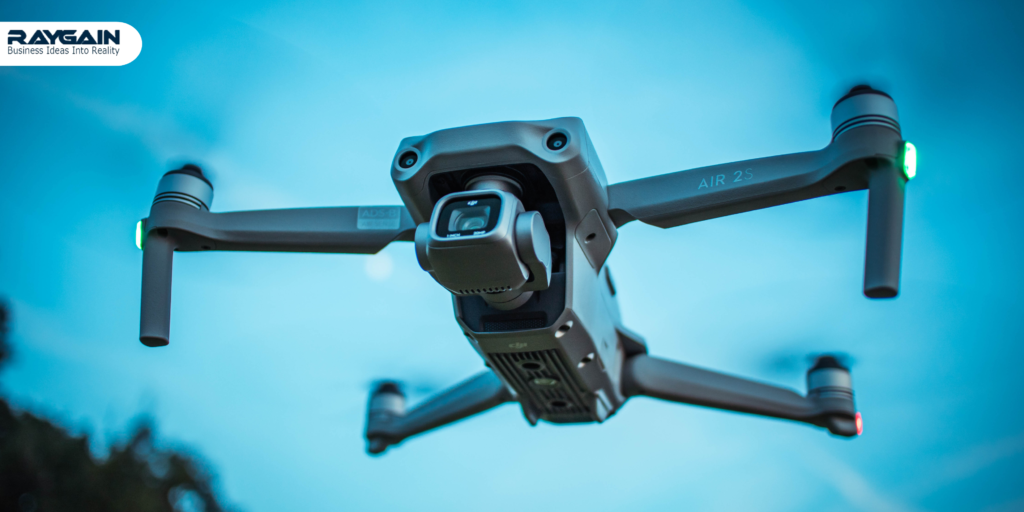
In today’s high-stakes security landscape, businesses are turning to smarter, faster, and more efficient technologies to protect their assets, people, and infrastructure. One standout solution leading this transformation is drone surveillance. Drones, or unmanned aerial vehicles (UAVs), have evolved beyond photography and hobby use—they now play a critical role in industrial, commercial, and public safety operations. Equipped with high-resolution cameras, thermal sensors, and real-time data transmission capabilities, drone surveillance systems offer an unmatched advantage in proactive security and monitoring. So, why are so many businesses investing in drone surveillance systems? Let’s break it down. 1. Enhanced Perimeter Security Traditional perimeter security often relies on fixed CCTV cameras or ground patrols, both of which have limitations in coverage and flexibility. Drone surveillance overcomes these limitations by offering: For large facilities, construction sites, oil fields, and warehouses, drones enable rapid situational awareness and faster response times to threats. 2. Real-Time Monitoring and Faster Response Drone surveillance systems are equipped with live-streaming capabilities that allow command centers and security teams to monitor activities in real-time. Unlike static cameras that may miss critical angles, drones can be deployed instantly to follow targets, assess incidents, and guide response teams on the ground. This real-time visibility helps businesses: 3. Cost-Effective Security Solution Many companies assume drone surveillance is expensive. In reality, it offers significant cost savings compared to traditional methods. Here’s how: By automating routine surveillance tasks, drones allow businesses to reallocate human resources to more strategic roles. 4. High-Resolution Imaging and Advanced Sensors Modern drone surveillance systems are equipped with 4K cameras, night vision, thermal imaging, and AI-powered analytics. These tools are game-changers in security, enabling businesses to: Such capabilities make drones ideal not just for security, but also for predictive maintenance and safety inspections. 5. Safety in Hazardous and Remote Environments Industrial environments such as oil refineries, chemical plants, and power substations can be dangerous for manual inspection. Drone surveillance provides a safe alternative by accessing these areas without putting personnel at risk. With pre-programmed flight paths and AI-assisted navigation, drones can perform routine security checks, monitor emissions, or inspect hard-to-reach structures—enhancing both safety and efficiency. 6. Scalability and Flexibility Whether you’re managing a single facility or multiple sites across different regions, drone surveillance systems are highly scalable. Businesses can: This flexibility makes drone surveillance ideal for evolving business environments and growing operational demands. 7. Seamless Integration with Smart Security Systems Drone surveillance is not a standalone tool—it integrates easily with other smart technologies such as: At Raygain Technologies, we help businesses unify drone surveillance with their broader industrial safety and automation frameworks. This creates a connected ecosystem where data from drones complements access control, cybersecurity, and smart asset monitoring. Why It’s More Than Just Surveillance Businesses are not just investing in drone surveillance for security—they’re investing in data, automation, and insight. Drones enable organizations to see more, know more, and act faster. From reducing theft and downtime to improving worker safety and compliance, the ROI of drone surveillance goes well beyond the security department. It becomes a strategic asset for digital transformation. Partner with Raygain Technologies for Smart Surveillance As drone technology continues to evolve, businesses need reliable partners to design, implement, and manage these systems effectively. At Raygain Technologies, we offer industry-grade drone surveillance solutions tailored to your unique operational challenges. Our expertise covers: To build an even safer and smarter industrial environment, many businesses are also integrating Connected Worker Systems alongside drone surveillance—creating a unified approach to real-time visibility and workforce safety.
Top 7 Benefits of Push to Talk Solutions in Industrial Workplaces

In fast-paced industrial environments, communication isn’t just important—it’s critical. Whether it’s a power plant, construction site, or manufacturing facility, teams need a secure, reliable, and immediate way to exchange information. This is where Push to Talk (PTT) solutions prove their value. Unlike traditional phone systems or two-way radios, push to talk offers instant, one-button communication across teams, devices, and distances. Let’s explore the top 7 benefits of push to talk in industrial workplaces. 1. Instant Communication for Faster Decision-Making Time is of the essence in industrial settings. Push to talk enables workers to connect instantly without dialing or waiting for a call to connect. Just press a button and speak—critical for emergencies, shift changes, or machinery updates. This real-time voice transmission enhances operational speed and helps teams respond to on-site situations without delay. 2. Improved Team Coordination and Collaboration Whether it’s maintenance crews, field technicians, or safety inspectors, teams can stay in constant touch using group or one-to-one push to talk channels. This creates a seamless flow of information across departments and locations. With integrated communication, supervisors can issue instructions, monitor work, and resolve issues collaboratively—boosting overall efficiency. 3. Enhanced Safety in Hazardous Environments Industrial workplaces often involve high-risk environments like heavy machinery, chemical processing, or confined spaces. Push to talk systems can be paired with rugged smartphones or smart helmets, enabling hands-free and voice-activated communication. This minimizes distractions, reduces the need to handle devices, and helps ensure that workers can stay focused and safe—even in noisy or dangerous conditions. 4. Wide-Area Coverage with Push to Talk Over Cellular (PoC) Traditional two-way radios are limited by range. Push to talk over cellular (PoC) uses 4G, 5G, or Wi-Fi networks to allow unlimited geographic communication. Workers in different locations—even across cities or countries—can communicate as if they’re in the same room. This makes PTT ideal for large-scale industrial operations or companies with distributed teams. 5. Better Resource Management and Incident Response Supervisors can track which teams are active, what tasks are being handled, and how quickly they’re responding—all in real time. Push to talk systems often include features like GPS tracking, audio recording, and time-stamped logs, enabling better oversight and reporting. In case of an incident or emergency, coordinated response is faster and more effective. 6. Cost-Effective Communication Infrastructure Unlike complex PBX systems or expensive radio towers, push to talk solutions can be deployed on existing smartphones, tablets, and wearables. There’s no need for dedicated hardware, making it a scalable and budget-friendly solution. With minimal training required and lower maintenance costs, businesses can enhance communication without straining their budgets. 7. Integration with Smart Industrial Systems Modern PTT platforms integrate seamlessly with IoT devices, maintenance software, digital inspection apps, and workforce management systems. This allows teams to: By digitizing communication, push to talk becomes part of a smarter, more connected industrial ecosystem. Push to Talk: A Game Changer for Industrial Communication From improved safety and faster response to cost savings and smart integration, push to talk solutions are transforming how industrial teams operate. As industrial workplaces embrace digital transformation, real-time communication is no longer optional—it’s a necessity. Looking to Digitally Upgrade Your Industrial Workforce? At Raygain Technologies, we specialize in secure, connected solutions for industrial environments—including push to talk, IoT, and workforce digitization. Our experts can help you choose and implement the best-fit communication tools for your facility. Explore more solutions to empower your workforce at Raygain Technologies.
PSV Explained: How Pressure Safety Valves Ensure Equipment Safety

In industries where high-pressure systems are used—such as oil and gas, chemical plants, and manufacturing facilities—safety is non-negotiable. One critical component that ensures this safety is the Pressure Safety Valve (PSV). Designed to protect equipment, processes, and personnel, a PSV acts as the last line of defense against pressure-related hazards. In this article, we’ll explain what a PSV is, how it works, and why it’s vital for modern industrial systems. 🔧 What is a PSV? A Pressure Safety Valve (PSV) is a mechanical device designed to automatically release pressure from a system when it exceeds a preset limit. Unlike other pressure control components, a PSV operates independently—without the need for electrical or manual intervention—ensuring immediate response during overpressure conditions. PSVs are widely used in pressure vessels, boilers, storage tanks, and pipelines where overpressure can lead to catastrophic failure or explosion. ⚙️ How Does a PSV Work? The working principle of a PSV is based on a spring-loaded mechanism. Here’s a simplified explanation: This rapid and reliable action prevents damage to critical equipment and ensures operational continuity. 🛡️ Why Are PSVs So Important? Overpressure can occur due to equipment failure, process upsets, or external conditions. Without a PSV, the consequences can be severe, including: A well-installed and maintained PSV mitigates these risks and ensures compliance with international safety standards. 🏭 Industries That Use PSVs PSVs are essential across multiple sectors, such as: 🔍 Common Types of PSVs There are several types of PSVs tailored to specific industrial needs: Each type offers unique benefits depending on system requirements. 📋 Key Factors for Choosing a PSV When selecting a PSV, several factors must be considered: Working with a reliable engineering partner like Raygain Technologies ensures the correct PSV selection for your operational needs. 🧰 PSV Maintenance and Inspection To maintain efficiency and safety, regular inspection and testing of PSVs are crucial. Maintenance tasks include: Failing to maintain a PSV can result in malfunction or non-compliance with regulatory standards. 💡 Raygain Technologies: Your Partner in Industrial Safety At Raygain Technologies, we understand the importance of robust safety systems in industrial environments. Our experts offer: Whether you’re upgrading existing systems or building new infrastructure, our goal is to keep your operations safe, compliant, and efficient. 🔗 Conclusion A PSV may look small, but its impact on industrial safety is massive. By instantly and reliably relieving excess pressure, PSVs protect lives, equipment, and production integrity. Choosing the right PSV and maintaining it properly is essential for every pressure-based system. Looking to enhance your industrial safety strategy or explore related innovations in pressure management and automation? Learn more from our latest insights and solutions designed to keep your operations safe, efficient, and future-ready.
OT Security vs IT Security: Key Differences Explained

In today’s hyper-connected industrial landscape, understanding the difference between OT security and IT security is more than a technical requirement—it’s a business imperative. While both aim to protect critical systems and data, the stakes, priorities, and strategies differ significantly between the two. In this blog, we’ll break down what OT security is, how it contrasts with IT security, and why modern enterprises must approach them with distinct strategies. What Is OT Security? OT (Operational Technology) security refers to the protection of systems that control physical processes—like machinery, production lines, industrial robots, and critical infrastructure. OT systems are widely used in manufacturing, energy, transportation, and utilities. These systems include: Because OT environments manage real-world operations, breaches can lead to physical damage, safety risks, and major operational disruptions. What Is IT Security? IT (Information Technology) security, on the other hand, is focused on securing data, digital communications, and computing systems like: The goal is to protect information from unauthorized access, data breaches, and cyberattacks. Key Differences Between OT and IT Security Let’s explore the major distinctions: 1. Purpose and Priorities 2. System Lifespan 3. Network Architecture 4. Response to Threats 5. Attack Surface Why OT Security Is Gaining Urgency As industries move toward Industry 4.0 and integrate IIoT (Industrial Internet of Things), the gap between IT and OT continues to narrow. This convergence increases the attack surface and makes OT systems more vulnerable than ever. High-profile incidents like the Stuxnet worm, Colonial Pipeline attack, and Oldsmar water treatment breach have shown that cyberattacks on OT environments can lead to real-world damage, regulatory action, and loss of public trust. OT and IT Security Must Work Together While OT and IT security strategies differ, they must align to ensure complete organizational protection. This integrated approach is known as converged cybersecurity. Key Steps Toward OT-IT Security Integration: How Raygain Technologies Can Help At Raygain Technologies, we understand the unique challenges of OT security and how it must align with IT strategies. Our experts design and deploy tailored security frameworks for industrial environments that safeguard both your digital and physical assets. We specialize in: With our deep domain expertise in manufacturing, critical infrastructure, and automation, we ensure your operations remain secure, compliant, and future-ready. Conclusion The differences between OT security and IT security are fundamental—but increasingly interwoven in today’s smart, connected ecosystems. Understanding their unique roles and challenges is key to building a resilient, secure enterprise. As operational systems become smarter and more connected, your approach to OT security must be just as agile and intelligent. 📩 Need help securing your OT environment? Raygain Technologies offers expert solutions in industrial automation, cybersecurity, and connected systems—all tailored to modern operational needs. Explore how we can help you protect your critical infrastructure and ensure business continuity.
Why Data Diodes Are Essential for Government and Defense Security

In an age of relentless cyber threats, traditional firewalls and software-based defenses are no longer sufficient to protect sensitive government and defense systems. This is where Data Diodes come into play—offering a foolproof hardware-based security solution that ensures one-way data flow and zero data leakage. For organizations like military agencies, intelligence units, and national defense contractors, Data Diodes are not just an option—they are a necessity. In this blog, we’ll explore what data diodes are, how they work, and why they are essential for safeguarding national infrastructure. What Are Data Diodes? Data Diodes are specialized hardware devices designed to enforce unidirectional data flow between two networks. They allow data to travel in only one direction—from a source (such as a classified system) to a destination (like a monitoring network)—with no possibility of return traffic. This one-way mechanism ensures that sensitive or classified networks remain air-gapped and immune to external cyber intrusions, making them ideal for high-security sectors. Why Government and Defense Need Data Diodes Government and defense operations handle massive volumes of classified data, ranging from military intelligence to critical infrastructure command systems. The stakes are high, and so are the risks. Here’s why Data Diodes are essential in these domains: 1. Zero Trust Architecture Compliance In zero-trust security models, no entity—internal or external—is automatically trusted. Data Diodes perfectly support this philosophy by completely blocking any inbound communication to secure networks, reducing the attack surface to zero. 2. Protection from Advanced Persistent Threats (APTs) Nation-state cyber-attacks and persistent threats target military and government networks using sophisticated tools. Since data diodes physically block reverse traffic, they eliminate backdoors exploited by APTs. 3. Safe Data Replication and Monitoring Government and defense agencies need to monitor systems and log activity without risking exposure. Data Diodes enable this by securely sending logs, video feeds, or sensor data from secure zones to external analysis centers without the risk of intrusion. 4. Regulatory and Compliance Requirements Many defense standards such as NIST, NERC CIP, and DISA STIGs mandate strict data isolation practices. Data Diodes help agencies meet these regulatory demands with a proven, hardware-enforced solution. 5. Operational Continuity in Isolated Environments Data Diodes ensure that even isolated defense systems can securely transmit outbound data (like mission logs or telemetry) without connecting to external networks, thus preserving both functionality and security. Real-World Applications in Government & Defense Data Diodes vs. Traditional Firewalls While firewalls and software-based filters can be bypassed or misconfigured, Data Diodes rely on hardware-level enforcement. There are no protocols, no ports, and no chance for bidirectional data flow once installed. Feature Data Diodes Firewalls Unidirectional flow ✅ ❌ Immune to malware ✅ ❌ Hardware-based ✅ ❌ Requires patching ❌ ✅ Regulatory compliance High Moderate Why Choose Raygain Technologies for Data Diode Solutions? At Raygain Technologies, we understand that national security demands more than just good software—it demands absolute trust in infrastructure. Our custom-built Data Diode solutions are designed for scalability, integration, and compliance with government and military standards. We offer: We ensure your most sensitive data remains secure, traceable, and tamper-proof—always. Final Thoughts Cybersecurity is no longer just about preventing attacks—it’s about ensuring resilience and continuity in the face of sophisticated threats. For government and defense sectors, Data Diodes provide the ultimate level of trust and control by physically eliminating the risk of data leakage and external compromise. If your organization is serious about protecting its mission-critical systems, Data Diodes are no longer optional—they’re essential. Learn how Raygain Technologies provides secure data diode solutions for mission-critical environments. Contact us for a custom deployment strategy.
Why Connected Worker Systems Are Essential for Modern Manufacturing

The manufacturing industry is undergoing a rapid digital transformation, and one of the most impactful innovations leading this change is the concept of connected workers. By integrating advanced technologies such as RTLS (Real-Time Location Systems), IoT, WiFi-enabled ID cards, and data analytics, connected worker systems empower organizations to enhance safety, increase productivity, and optimize workforce operations. Raygain Technologies delivers cutting-edge connected worker solutions tailored to the demands of large-scale industrial environments, including expansive facilities up to 5km x 5km. What Are Connected Workers? Connected workers are employees equipped with digital tools and wearable devices that collect, transmit, and analyze data in real-time. These tools enable seamless communication, location tracking, task monitoring, and instant alerts, forming a smart and secure operational ecosystem. By leveraging WiFi-enabled ID cards and RTLS routers, the connected worker system ensures that each worker’s location, safety compliance, and productivity are tracked and optimized without manual intervention. Why Connected Worker Systems Matter in Modern Manufacturing Manufacturers today face increasing pressure to deliver high output while maintaining strict safety standards and operational transparency. Here’s why connected workers are now essential: 1. Real-Time Location Tracking Connected worker systems use RTLS WiFi routers to provide accurate, real-time location data for all personnel. This level of visibility enhances workforce management, reduces idle time, and supports quicker emergency response. 2. Improved Safety Compliance Safety is a top priority in industrial operations. With live tracking, geofencing, and automatic alerts, connected workers help enforce safety zones, PPE compliance, and restricted area access—drastically reducing workplace incidents. 3. Operational Efficiency Data gathered from connected devices can uncover inefficiencies, monitor work patterns, and identify areas for improvement. This leads to better task allocation, leaner operations, and maximized output. 4. Automated Attendance and Time Tracking Manual logging is both time-consuming and error-prone. Connected worker systems automate attendance, shift changes, and break tracking—ensuring accurate records for payroll and compliance. 5. Informed Decision Making with Data Analytics The centralized software platform aggregates data from all connected devices, offering visual dashboards and analytical insights. These insights aid in strategic planning, operational fine-tuning, and predictive maintenance. Key Components of Raygain’s Connected Worker System Raygain Technologies offers a robust connected worker solution designed for large-scale manufacturing. Here are the main components: Benefits of Implementing Connected Worker Systems Companies that adopt Raygain’s connected worker system enjoy a wide range of benefits: Challenges Without Connected Workers Without connected worker technology, manufacturing units often deal with: Connected worker systems directly address these gaps with real-time intelligence and automation. Real-World Impact: Raygain’s Implementation In a 5km x 5km industrial facility in India, Raygain Technologies implemented a connected worker system integrating WiFi routers and smart ID cards. The system provided end-to-end tracking, reduced safety incidents by over 40%, and improved resource utilization significantly. The system was supported with: Conclusion Connected workers are no longer a futuristic concept—they’re a necessity for modern manufacturing success. From improving operational oversight to enhancing safety and compliance, these systems are transforming how industries function. Raygain Technologies is at the forefront of this transformation, offering scalable, real-time solutions that drive performance, productivity, and workforce intelligence. To learn more about Raygain’s connected worker solutions, explore how we can help you build a smarter, safer manufacturing environment.
Smart Helmet Technology: A Game Changer in Operational Efficiency

In today’s fast-evolving industrial landscape, operational efficiency and worker safety are non-negotiable. Businesses across the construction, manufacturing, logistics, and energy sectors are turning to innovative solutions to bridge the gap between performance and protection. One such breakthrough innovation is the smart helmet—a wearable technology transforming how operations are managed, risks are identified, and decisions are made in real time. What Is a Smart Helmet? A smart helmet is an advanced, connected safety helmet equipped with 5G cameras, sensors, AI analytics, and real-time communication systems. These helmets are designed to collect, analyze, and transmit critical data instantly, enabling faster decision-making and greater situational awareness. By combining traditional head protection with smart capabilities, smart helmets are becoming essential tools for modern enterprises looking to enhance safety and boost productivity simultaneously. Key Features of Smart Helmets Smart helmets are engineered with cutting-edge features that go beyond basic protection. Here are some of the most powerful functionalities: These capabilities make smart helmets indispensable for industries where rapid response, data accuracy, and safety compliance are critical. How Smart Helmets Improve Operational Efficiency 1. Real-Time Decision Making Smart helmets deliver on-the-spot insights through AI and sensors, enabling teams to act on potential hazards, equipment failures, or environmental anomalies instantly. This drastically reduces downtime and supports quicker problem-solving. 2. Enhanced Workforce Productivity By equipping employees with real-time data, visual overlays, and hands-free communication, smart helmets eliminate the need for manual checks or reliance on distant supervisors. This leads to more efficient workflows and reduced human error. 3. Predictive Maintenance The ability to detect machinery stress, overheating, or irregular vibrations before a failure occurs empowers teams to schedule timely maintenance. This predictive capability minimizes unexpected breakdowns and ensures equipment longevity. 4. Remote Collaboration Smart helmets with live video streaming allow experts to guide field workers remotely, improving knowledge sharing and reducing the need for physical presence. This is especially valuable in hazardous or remote work environments. 5. Improved Safety Compliance Smart helmets monitor environmental data like temperature, air quality, and proximity to hazardous zones, alerting users and management when thresholds are breached. This proactive approach to safety reduces accidents and regulatory risks. Industries Benefiting from Smart Helmets The utility of smart helmet technology extends across multiple sectors: Smart Helmet Adoption in the USA As digital transformation accelerates across the USA, companies are investing in smart technologies that optimize both human and operational capital. With increasing focus on OSHA compliance, workforce safety, and Industry 4.0 integration, smart helmets are becoming a core part of enterprise digital infrastructure. Why Choose Raygain Technologies? At Raygain Technologies, we offer industry-leading smart helmet solutions built for the modern business environment. Our smart helmets are designed with AI-powered analytics, 5G connectivity, and rugged usability tailored for USA-based industries. Whether your goal is real-time safety monitoring, enhanced field collaboration, or predictive maintenance, Raygain delivers innovation that works. Visit our Smart Helmet page to explore the full potential of our technology.